In India, solar panels produce the most when they face due south and are tilted at roughly your latitude — from about 10° in the far south to around 30° in the far north.
That is the textbook answer, and it's a good one. But on a real rooftop, the best angle also has to respect wind load, row spacing, parapets, roof slope and how many panels you want to fit. This guide explains why south and latitude work, gives a city-wise tilt table, compares low-tilt and east-west layouts, shows how tilt affects row spacing, and covers what to do on tin sheds and awkward roofs.
Key points
- Face panels due south; south-east or south-west costs only a little, east or west noticeably more, and north-facing should be avoided.
- A fixed tilt close to your latitude maximises yearly generation, and a few degrees either way changes it only slightly.
- Many rooftops use a lower tilt (10–20°) to cut wind load and fit rows closer together, accepting a small loss; keep at least about 10° so rain can wash the panels.
- Steeper tilts throw longer winter shadows, so rows need more space; a 3D design sets tilt and spacing together.
Why south, and why latitude?
India lies in the northern hemisphere, so the sun travels across the southern part of the sky — high in summer, low in winter. Panels facing south see the sun for the longest part of the day. Tilting them up towards the sun's average height through the year, which is set by your latitude, keeps them closer to facing the sun head-on for more of the year.
Near the equator the sun is almost overhead at midday, so the best tilt is shallow. Further north it sits lower in the southern sky, so the best tilt is steeper. That's why Chennai and Bengaluru suit low tilts and Delhi or Chandigarh suit steeper ones.
Which direction should panels face?
| Direction | Generation | When it makes sense |
|---|---|---|
| South | Highest | Always the first choice |
| South-east / south-west | Slightly lower | When the roof or shade makes due south awkward |
| East-west (back to back) | Lower per panel, flatter daily curve | Large flat roofs where fitting more panels matters most |
| East or west only | Noticeably lower | Tin-shed slopes or roofs with no other option |
| North | Lowest | Avoid, especially at higher tilts |
The closer you are to the equator and the flatter the panels, the less direction matters. At a steep tilt in north India, facing the wrong way costs much more than at a low tilt in Tamil Nadu.
“South and latitude are the textbook answer. Wind, rows and roof space decide the practical one.”
City-wise tilt angle table
For a fixed, south-facing array, a tilt close to the city's latitude maximises yearly generation. The practical range shows angles that typically keep generation close to the maximum; the final choice depends on wind, structure and row spacing.
| City | Latitude | Tilt for maximum yearly output | Common practical range |
|---|---|---|---|
| Chandigarh | 30.7° N | ~30° | 20–30° |
| Delhi | 28.6° N | ~28° | 18–28° |
| Jaipur | 26.9° N | ~27° | 17–27° |
| Lucknow | 26.8° N | ~27° | 17–27° |
| Guwahati | 26.1° N | ~26° | 16–26° |
| Patna | 25.6° N | ~25° | 15–25° |
| Bhopal | 23.3° N | ~23° | 13–23° |
| Ahmedabad | 23.0° N | ~23° | 13–23° |
| Indore | 22.7° N | ~23° | 13–23° |
| Kolkata | 22.6° N | ~22° | 12–22° |
| Surat | 21.2° N | ~21° | 11–21° |
| Nagpur | 21.1° N | ~21° | 11–21° |
| Mumbai | 19.1° N | ~19° | 10–19° |
| Pune | 18.5° N | ~18° | 10–18° |
| Visakhapatnam | 17.7° N | ~18° | 10–18° |
| Hyderabad | 17.4° N | ~17° | 10–17° |
| Chennai | 13.1° N | ~13° | 10–13° |
| Bengaluru | 13.0° N | ~13° | 10–13° |
| Coimbatore | 11.0° N | ~11° | 10–11° |
| Kochi | 9.9° N | ~10° | ~10° |
The tilt for maximum yearly output is close to latitude; local climate, especially a long monsoon or winter haze, can shift the true optimum by a few degrees. A site-specific simulation gives the exact figure.
Does the exact angle matter much?
Less than most people think. Yearly generation changes slowly near the optimum, so a few degrees either way makes only a small difference. What matters far more is avoiding shade, facing roughly south and keeping the panels clean. This is why many Indian rooftop systems use a lower, practical tilt rather than the textbook one.
Low tilt vs latitude tilt on a rooftop
| Low tilt (10–15°) | Near-latitude tilt | |
|---|---|---|
| Yearly generation per panel | Slightly lower in the north; about the same in the south | Highest |
| Wind load on the structure | Lower | Higher; needs a stronger structure and anchoring |
| Gap needed between rows | Smaller | Larger |
| Panels that fit on the roof | More | Fewer |
| Self-cleaning in rain | Good above about 10° | Good |
On a space-limited terrace, fitting more panels at a slightly lower tilt often produces more total units than fewer panels at the ideal tilt. On an open roof with plenty of space, the near-latitude tilt wins.
Tilt and row spacing
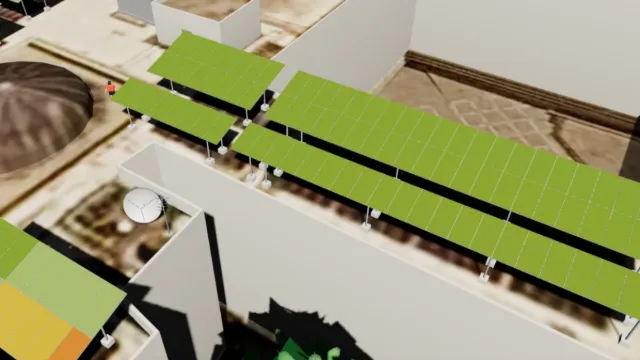
Every row of tilted panels casts a shadow behind it. The steeper the tilt and the further north you are, the longer that shadow — and it is longest around the winter solstice in late December, when the sun is lowest. A common design aim is to keep rows free of each other's shadow during the main generating hours, roughly 9 am to 3 pm, even on the shortest days.
- The required gap grows with the height of the tilted panel edge and with your latitude.
- Lower tilts need smaller gaps, which is another reason flatter arrays fit more panels.
- Parapets, tanks and staircase rooms cast shadows too — see rooftop shading.
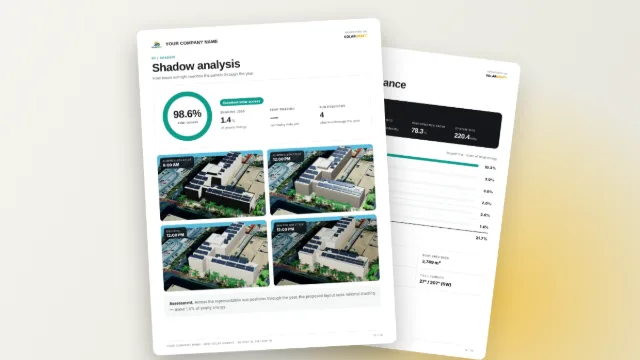
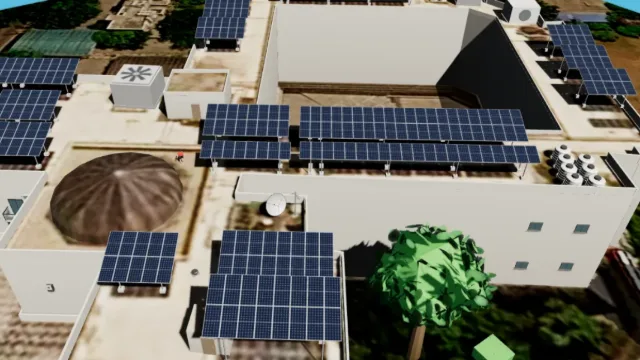
A 3D design calculates tilt, row spacing and shading together on the actual roof, so you can compare options before choosing.
East-west layouts
An east-west layout places panels back to back at a low tilt, half facing east and half facing west. Each panel produces less than a south-facing one, but there are no large gaps between rows, so many more panels fit on a flat roof. Generation is spread more evenly through the day, and the low profile reduces wind load. East-west suits large commercial roofs where total capacity matters more than output per panel — see commercial vs residential solar.
Tin sheds, slopes and elevated structures
- Tin-shed roofs — panels usually follow the roof slope, so orientation is set by the shed. Use the south-facing slope where possible; a north-facing slope at a steep pitch is a poor choice for panels.
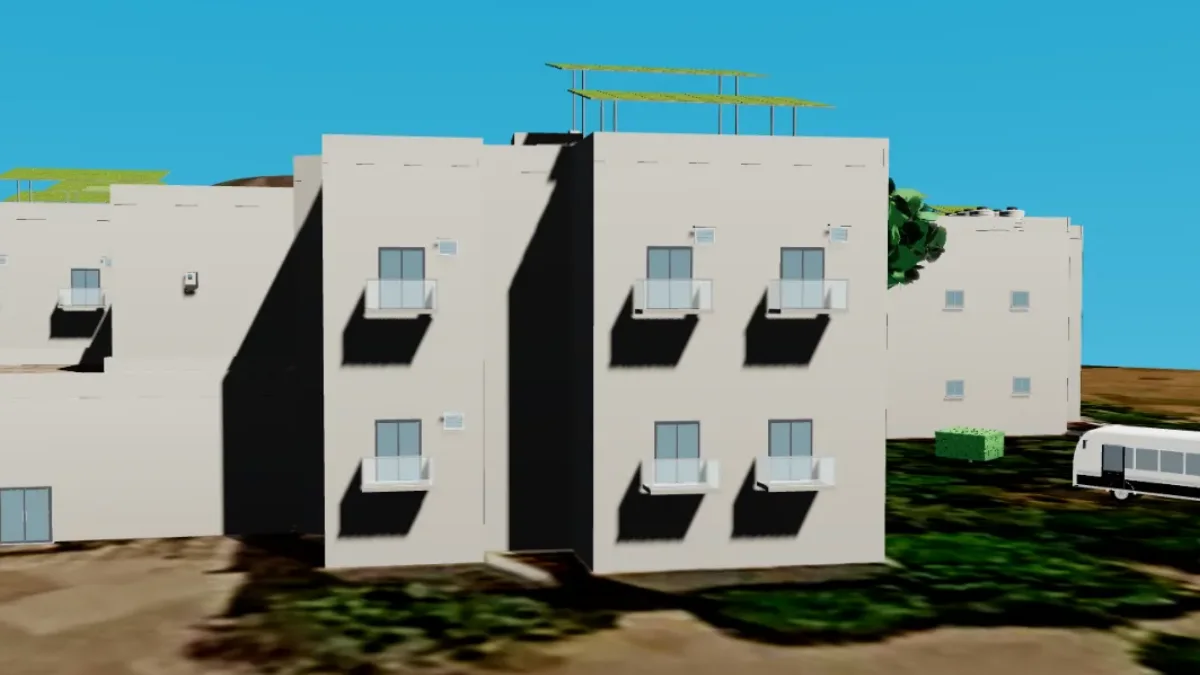
- Elevated structures — common on Indian terraces; they lift panels above parapets and keep the terrace usable, and the tilt can be chosen freely.
- Ground mounts and agrivoltaics — with no roof constraints, tilt and orientation can be optimised for output; see ground-mounted vs rooftop solar.
Should you adjust the tilt by season?
A steeper tilt helps in winter and a flatter one in summer, and seasonally adjustable mounts exist. On rooftops, though, the small extra generation rarely justifies the extra structure cost, labour and safety risk of adjusting panels twice a year. A well-chosen fixed tilt is the standard choice. Large utility plants sometimes use single-axis trackers instead, which follow the sun automatically.
“Get the direction right, keep the shade off, and the tilt only has to be close.”
Tilt and direction feed straight into generation — see how many units 1 kW of solar generates. SolarDraft's Solar 3D Design lets you set tilt and orientation on the real roof, check row spacing and shading across the year, and carry the result into the proposal.
FAQ
Is a 15° tilt fine in Delhi?
Yes. It produces a little less per panel than a near-latitude tilt, but it lowers wind load and lets rows sit closer, which often means more panels and more total units on a crowded terrace.
If south isn't possible, is east or west better?
They produce similar yearly totals; east favours mornings and west afternoons. Under net metering the timing matters less, so choose the side with less shade.
Can panels be laid flat?
Very flat panels collect dust and rainwater and lose some output. Keep at least about 10° so rain can wash them.
What is the best direction for solar panels in South India?
Still south, but because the sun is nearly overhead, low tilts work well and the penalty for other directions is smaller than in the north.