Solar panels typically carry two separate warranties, and confusing them causes most post-installation disputes.
A rooftop solar system is really a collection of warranties: the panel manufacturer's, the inverter manufacturer's, the structure supplier's and the installer's own workmanship guarantee. Customers often hear “25-year warranty” and assume everything is covered for 25 years. It isn't. This guide explains each warranty, what it covers, what it doesn't, how to compare warranties between quotes, and how to make a claim if something goes wrong.
Key points
- Panels have a product warranty (defects, often 10–12 years) and a separate performance warranty (output, usually 25 years, sometimes 30).
- Inverters have shorter warranties, and the installer's workmanship warranty covers installation faults.
- Warranties don't cover storms, fire, rough handling, dust or shading; insurance covers some of those risks.
- Keep invoices, serial numbers and generation records — they are what a claim depends on.
The two panel warranties
- Product warranty — often 10–12 years, covers manufacturing defects.
- Performance warranty — usually 25 years, guarantees output above a set percentage.
- Inverters carry a separate, shorter warranty (often 5–10 years).
Product warranty
The product (or materials) warranty covers defects such as delamination, broken junction boxes, faulty bypass diodes or frame failures that aren't caused by damage. Some premium and newer-technology panels now offer longer product warranties, so check the datasheet.
Performance warranty
The performance (or power output) warranty guarantees the panel will still produce a minimum share of its rated power after a set number of years — for example, at least 98% in year one and around 84–85% at year 25 for many mono PERC panels. If a panel falls below that line, the manufacturer repairs, replaces or compensates. The curve behind this is explained in Solar Panel Degradation Explained.
“A 25-year warranty doesn't mean the panel is replaced free for 25 years — it means output is guaranteed.”
Product vs performance, side by side
| Product warranty | Performance warranty | |
|---|---|---|
| Covers | Manufacturing defects in the panel | Output falling below the guaranteed curve |
| Typical length | 10–12 years, longer on some panels | 25 years, 30 on some newer panels |
| Example claim | Junction box failure, delamination | Panel tests well below its guaranteed output |
| Evidence needed | Invoice, serial number, photos | Invoice, serial number, generation records, test results |
The rest of the system
| Component | Typical warranty | Given by |
|---|---|---|
| Panel (product) | 10–12 yrs | Manufacturer |
| Panel (performance) | 25 yrs (30 for some newer panels) | Manufacturer |
| Inverter | 5–10 yrs, sometimes extendable | Manufacturer |
| Mounting structure | Varies by material and supplier | Supplier / EPC |
| Workmanship | Varies by installer | EPC |
| Battery (if any) | Years and/or cycles, by chemistry | Manufacturer |
The inverter usually has the shortest warranty and is the component most likely to need replacement during the system's life. The workmanship warranty from your EPC covers installation faults — loose connections, leaks around roof penetrations, poor cable routing. For subsidised residential systems under PM Surya Ghar, the scheme also sets maintenance expectations for vendors in the early years, so check the current terms with your installer.
What warranties usually don't cover
- Physical damage from storms, falling objects, fire or rough handling.
- Damage from incorrect installation, unless covered by the installer's workmanship warranty.
- Output loss from dust, shading or a dirty array — see the maintenance checklist.
- Systems modified or repaired by unauthorised people.
- Normal wear such as minor cosmetic changes that don't affect output.
For storm, theft and fire risk, ask about adding the system to your home or business insurance.
How to compare warranties between quotes
Two quotes can both say “25-year warranty” and mean very different things. Ask for the datasheet and warranty document for each panel and inverter, then compare:
- Product warranty length — longer is better, and shows the manufacturer's confidence.
- Performance curve — a linear warranty with a small first-year drop beats a two-step warranty.
- Service in India — can claims be made locally, or only through an overseas office?
- Inverter extension options — useful because the inverter is the part most likely to fail.
- Workmanship cover — how long, and what exactly is included?
How to make a claim
- Keep the invoice, panel serial numbers and warranty cards in one place.
- Record generation from your inverter app — it's the evidence for a performance claim.
- Contact your EPC first; they'll usually test the system and raise the claim with the manufacturer.
- Expect an inspection and, for performance claims, a measurement of the panel's output.
- Get the outcome in writing — repair, replacement or compensation.
Questions to ask before you buy
- Which panel and inverter brands, and what exactly do their warranties say?
- Is the manufacturer's warranty serviced in India?
- What does the installer's workmanship warranty cover, and for how long?
- Who do I call, and how fast will they respond?
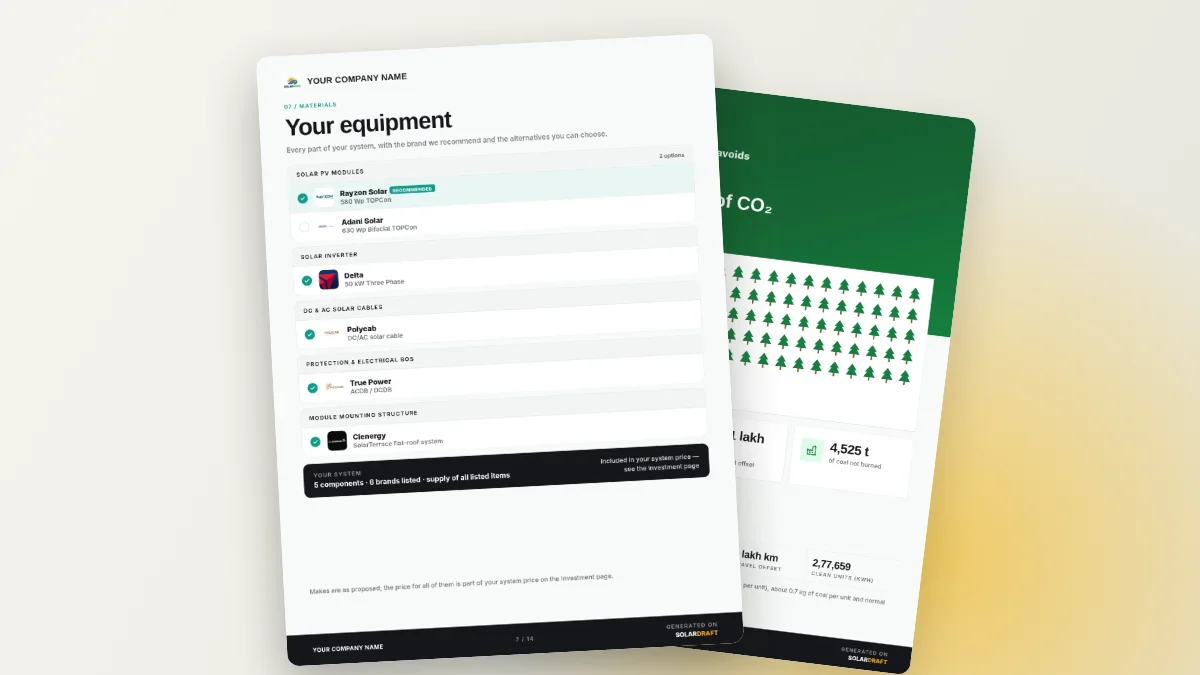
Our guide on how to choose a solar EPC contractor covers more questions to ask. EPCs can list equipment and warranty terms clearly in every quote with Solar Proposal — the equipment page is shown in our proposal samples.
Warranties and insurance work together
Warranties protect you against defects and under-performance; insurance protects you against events such as storms, fire and theft. A complete plan has both. When you buy, ask the installer for a single sheet that lists every warranty, its length, who gives it and how to claim, and add the system's value to your property insurance. For businesses, a maintenance contract with regular reports also creates the records that make any future claim straightforward.
“The warranty you understand before signing is the only one you'll be able to use later.”
Understand what “25 years” really means in Solar Panel Degradation Explained and How Long Do Solar Panels Actually Last?
FAQ
Can cleaning void my warranty?
Harsh cleaning can: pressure washers, abrasive pads or chemicals may damage coatings and seals. Follow the maintenance checklist and the manufacturer's guidance.
What proof do I need for a performance claim?
Your invoice, the panel serial numbers, and generation records from the inverter app. The manufacturer will usually test the panels before deciding.
Is the warranty valid if the installer closes down?
Manufacturer warranties stay valid; you can claim through the brand's service network. Workmanship warranties depend on the installer, which is another reason to choose an established EPC.
Does the warranty transfer if I sell my house?
Many manufacturer warranties stay with the panels, but terms vary. Check the warranty document and keep the paperwork with the property.