Panel type affects efficiency, the roof space you need, how the system copes with heat, and the price — not just the numbers on the spec sheet.
Ten years ago, the choice in India was mostly between polycrystalline and monocrystalline panels. Today, polycrystalline has largely given way to monocrystalline PERC, and newer cell technologies such as TOPCon and heterojunction (HJT) are becoming common, often in bifacial, glass-glass formats. This guide explains each type in plain language, what to read on a datasheet, how panel choice changes the layout, and how to pick the right panel for a rooftop or ground-mounted project.
Key points
- Monocrystalline PERC is the mainstream rooftop choice; TOPCon and HJT offer higher efficiency, better heat performance and often 30-year warranties.
- Polycrystalline is cheaper per panel but needs more roof area, so it rarely suits space-limited rooftops now.
- Bifacial panels add generation on raised structures, carports and ground-mounts over light-coloured surfaces.
- For PM Surya Ghar, panels must meet the domestic content requirement (DCR); check wattage, size, temperature coefficient and warranty too.
Quick comparison
| Type | Typical efficiency | Best for |
|---|---|---|
| Polycrystalline | 15–17% | Large roofs with spare space, tight budgets |
| Monocrystalline (PERC) | 19–22% | Most rooftops |
| TOPCon / HJT | 21–23%+ | Space-limited roofs, hot sites, long warranties |
| Bifacial | 21–24%* | Raised structures, carports, ground-mounts |
*Effective figure with a reflective surface below. Exact values vary by manufacturer and model — always check the datasheet.
The types in more detail
Monocrystalline PERC
Made from single-crystal silicon with an extra rear layer that reflects light back into the cell. PERC has been the workhorse of Indian rooftops for several years: good efficiency, wide availability and a proven track record.
TOPCon and HJT
Newer high-efficiency monocrystalline technologies. They generally lose less output in the first year and over time, cope better with heat, and are often sold with 30-year performance warranties. Prices have come down quickly, so they're increasingly common on rooftops too. See how degradation differs.
Polycrystalline
Made from multiple silicon crystals, recognisable by their blue, speckled look. Cheaper per panel but less efficient, so you need more roof area for the same output. Now rarely the best choice for space-limited rooftops.
Bifacial
Bifacial panels generate from both sides, picking up light reflected from the surface below. The gain depends on height and how reflective the ground or roof is: a white roof or light gravel helps; a dark roof very little. They shine on raised structures, carports and ground-mounts — see ground-mounted vs rooftop solar.
“The ‘best’ panel is the one that fits your roof's actual constraints, not the highest spec sheet.”
Other construction choices
- Half-cut cells — cells are cut in half and the panel is wired as two halves. This lowers internal losses and reduces the impact of partial shade on one half. Most modern panels use them.
- Glass-glass vs glass-backsheet — glass-glass panels have glass on both sides and are common for bifacial panels; they are tough and resist moisture, but heavier.
- Frame and mounting holes — check that the panel's size and mounting points suit the structure you plan to use.
What to check on a datasheet
| Datasheet item | Why it matters |
|---|---|
| Wattage (Wp) | Higher wattage means fewer panels for the same system size |
| Dimensions | Larger panels may not fit around tanks and parapets; the layout decides |
| Efficiency | More output per square foot of roof |
| Temperature coefficient | A lower figure means less output lost on hot Indian afternoons |
| Product and performance warranty | Years of cover and the guaranteed output curve |
| Certifications and DCR status | Needed for scheme eligibility, including PM Surya Ghar |
See the warranty guide for how to read the warranty section.
DCR panels and the subsidy
For PM Surya Ghar, panels must meet the scheme's domestic content requirement — panels made with Indian-manufactured cells, often called DCR panels. They usually cost a little more than non-DCR panels, but they are required for the subsidy on residential systems. Commercial projects without a subsidy can often choose either. Ask your installer to confirm the panel's DCR status in writing for every subsidised job.
How panel choice changes the layout
Panel choice directly affects how many panels you'll need and whether they fit:
| System size | Panels at ~545 W | Panels at ~400 W |
|---|---|---|
| 3 kW | 6 | 8 |
| 5 kW | 9–10 | 13 |
| 10 kW | 18–19 | 25 |
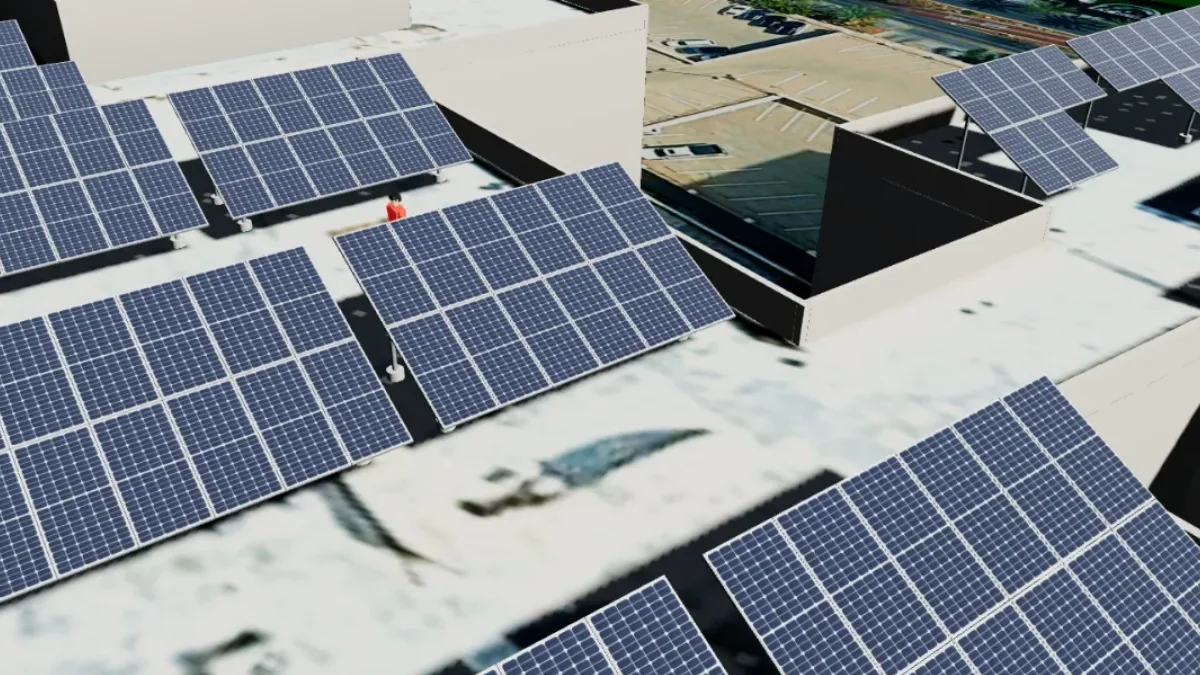
On a crowded terrace, a smaller number of larger panels doesn't always fit better — a big panel may not fit between a tank and a parapet where two smaller ones would. The quickest way to compare is to try both panels on a 3D design of the real roof and see which gives more kW after shading.
Brand, quality and after-sales
Two panels with the same wattage and technology can still differ in quality. Look for a manufacturer with a track record in India, a local service contact for warranty claims, and clear test certificates. Ask your installer how many of that model they have installed and whether they have had any failures. A slightly cheaper panel from an unknown brand can cost far more if its warranty is hard to claim in year eight.
Choosing for your roof
- Small or crowded roof — high-efficiency mono PERC or TOPCon to get the most kW from limited space.
- Raised structure, carport or parking shade — bifacial panels can add useful extra generation.
- Large open roof, tight budget — standard mono PERC is usually the best value.
- Hot, sunny sites — panels with a lower temperature coefficient hold output better in summer.
- Ground-mount — bifacial on a well-designed structure.
You can estimate the system size with the free solar size calculator, then confirm the panel choice on the design.
FAQ
Is polycrystalline still worth buying?
Only if roof space is plentiful and the price difference is large. For most rooftops, monocrystalline gives more value per square foot.
Are TOPCon panels worth the extra cost?
Often, yes, when roof space is limited or the warranty matters to the customer. Compare the price per watt and the expected generation over 25 years, not just the panel price.
What is a DCR panel?
A panel made with Indian-manufactured cells, meeting the domestic content requirement. Subsidised residential systems under PM Surya Ghar need them, and they usually cost a little more.
Do bifacial panels help on a normal concrete roof?
A little, especially on a raised structure over a light-coloured surface, but the biggest gains come on ground-mounts and canopies.