Most solar EPCs start with a spreadsheet — and outgrow it faster than they expect.
In the early months, the owner remembers every lead: who called, who wants a quote, whose neighbour already has solar. Then the Facebook ads start working, a second salesperson joins, and enquiries arrive faster than anyone can track them in their head or in a shared Excel file. That's usually the point where revenue quietly starts leaking. This guide explains what breaks without a CRM, what a solar-specific CRM should do, how to set one up, and the numbers it lets you finally see.
Key points
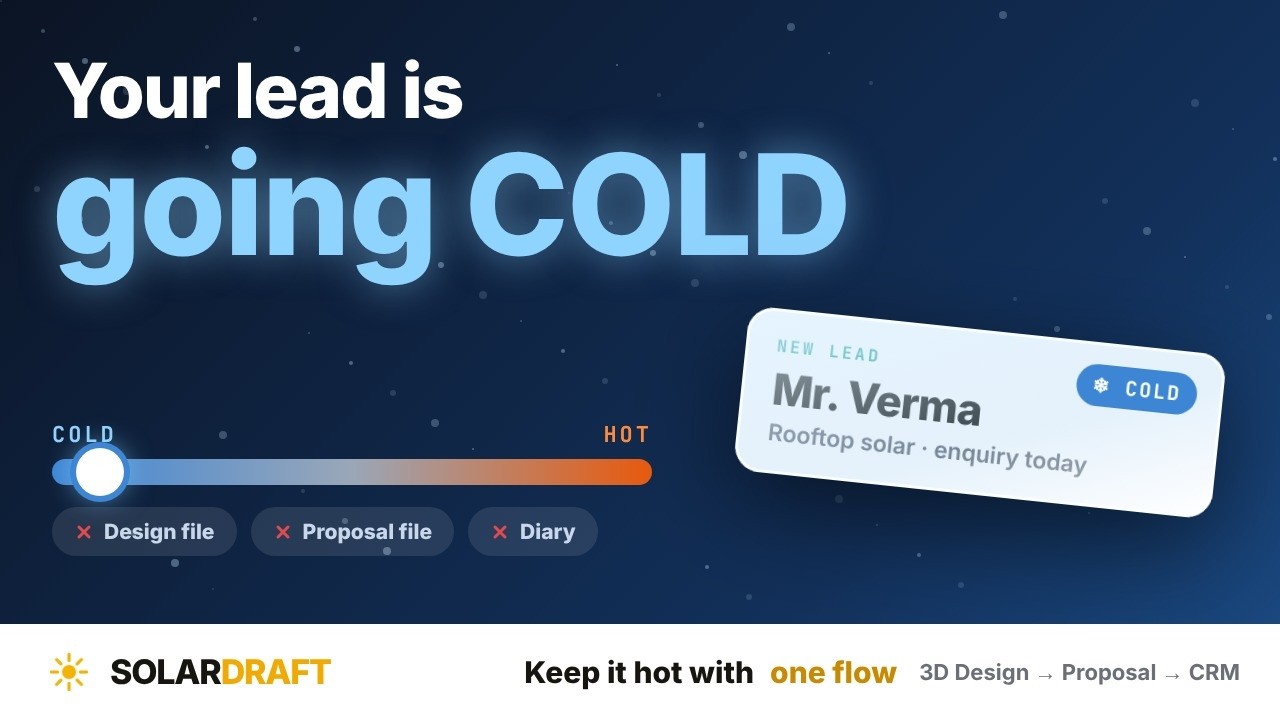
- Solar sales take several touchpoints over weeks or months; without reminders, leads go cold and competitors win them.
- A solar CRM should capture every lead, track clear stages, schedule follow-ups and keep the design and proposal on the same record.
- Spreadsheets usually break somewhere around 20–50 leads a month or the moment a second salesperson joins.
- Once leads live in a CRM, you can measure close rate, sales cycle and which lead sources actually bring orders.
What breaks without a CRM
- Leads sit untouched after the first call, with no reminder.
- No visibility into which stage each deal is stuck at.
- Handoffs between sales and installation teams get lost.
- Proposals are saved on one person's phone, so nobody else can follow up when they're away.
- The owner can't tell which lead source — ads, referrals, walk-ins — actually brings orders.
“A lead that isn't followed up within 48 hours is a lead you've effectively already lost.”
The solar sales cycle is long
A rooftop solar sale isn't a one-call decision. A homeowner typically enquires, books a site visit, receives a proposal, discusses it with family, compares two or three quotes, asks about the subsidy and loans, and only then decides. That can take anywhere from a week to a few months. Every one of those steps is a chance for the lead to go cold if nobody follows up at the right moment.
| Stage | What the customer is doing | What the EPC should do |
|---|---|---|
| New enquiry | Calling two or three installers | Call back the same day; book a site visit |
| Site visit | Judging how professional you are | Design the roof and send the proposal the same day |
| Proposal sent | Comparing quotes with family | Follow up within 48 hours; answer questions |
| Negotiating | Checking the subsidy, loan and timeline | Explain the payment schedule and paperwork |
| Won | Waiting for installation | Hand over to the installation team with the design |
| Lost | Chose someone else or postponed | Record the reason; set a reminder to re-contact |
What a solar CRM should do
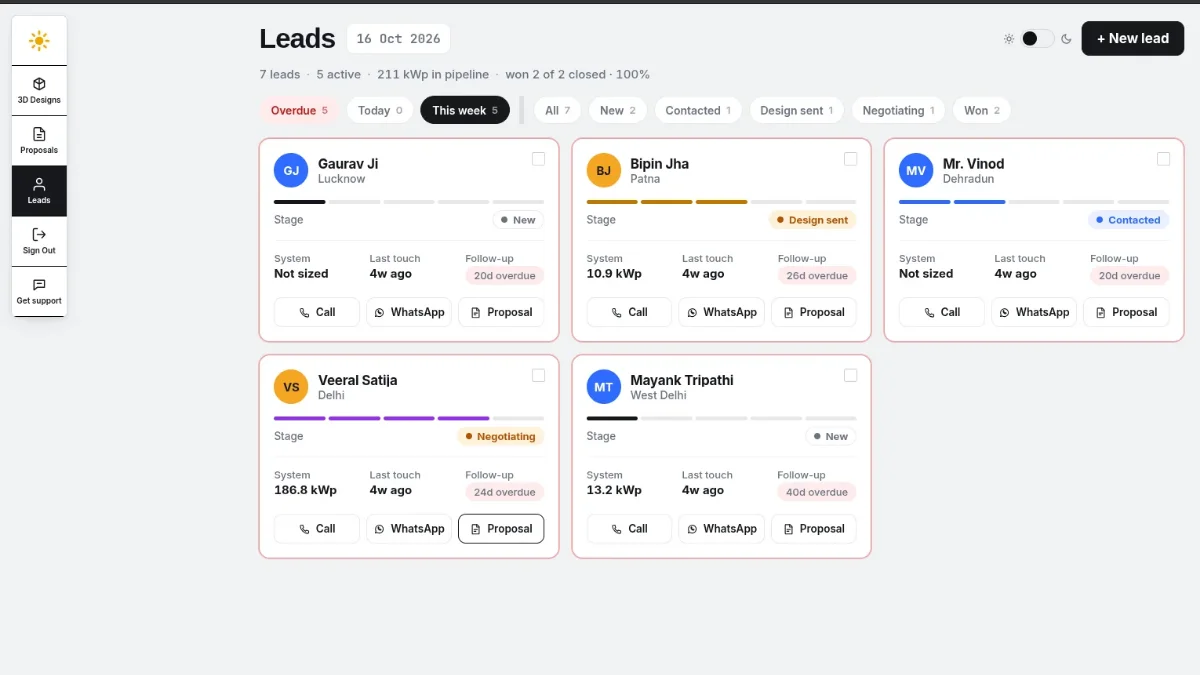
- Capture every lead with source, location and electricity bill or expected system size.
- Track clear stages — for example new, site visit, proposal sent, negotiating, won, lost.
- Schedule follow-ups and show what's due today and what's overdue.
- Keep the proposal on the lead, so anyone in the team can answer the customer's questions.
- One-tap call and WhatsApp, because that's how Indian customers actually respond.
- Admin view, so the owner can see each salesperson's pipeline without asking.
SolarDraft's Solar CRM is built around exactly this list. You can see real screens, with phone numbers hidden, on the samples page.
Spreadsheet vs CRM
| Spreadsheet | Solar CRM | |
|---|---|---|
| Follow-up reminders | Manual; easy to miss | Daily list of due and overdue follow-ups |
| Team access | File sharing, version confusion | Everyone sees the same live pipeline |
| Proposal and design | Stored separately | On the lead record |
| Calling and WhatsApp | Copy the number by hand | One tap from the lead |
| Reports | Built by hand, if at all | Stages, sources and team performance at a glance |
When a spreadsheet stops working
| Leads/month | Spreadsheet OK? | What usually happens |
|---|---|---|
| Under 20 | Maybe | Owner can track most leads personally |
| 20–50 | No | Follow-ups slip; duplicate calls; lost proposals |
| 50+ | No | No reliable view of the pipeline or team performance |
Connect the CRM to design and proposals
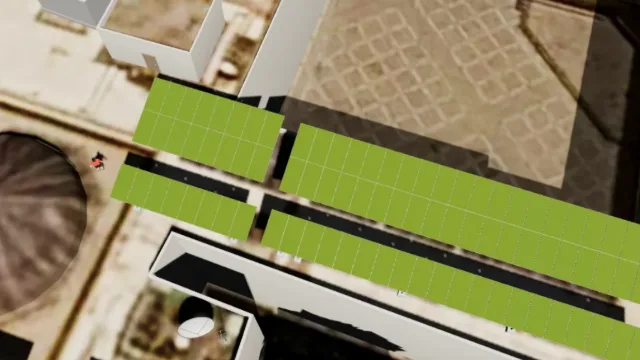
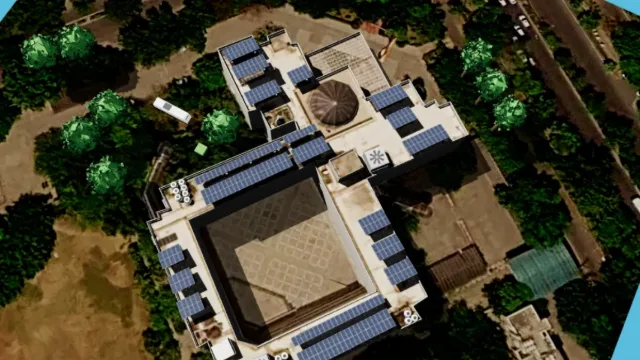
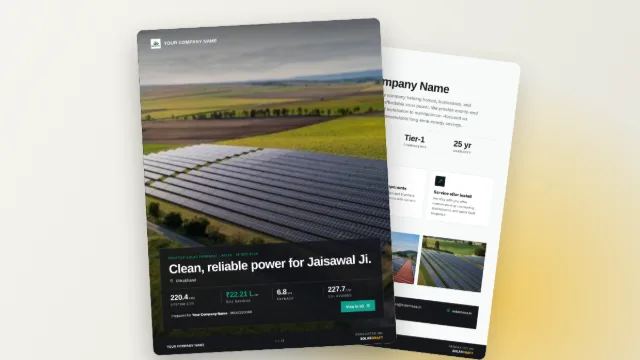
The biggest gain comes when the CRM isn't a separate island. If the 3D design and the proposal live on the same lead record, the salesperson can resend the proposal, change the system size or answer a pricing question in seconds. A dedicated Solar CRM pairs naturally with Solar Proposal for a single pipeline, and with Solar 3D Design for the design itself.
Setting it up in a week
- Define your pipeline stages and what moves a lead from one to the next.
- Import open leads from your spreadsheet, phone and WhatsApp chats.
- Assign every lead an owner and a next follow-up date.
- Agree a daily routine: overdue follow-ups first, every morning.
- Review the pipeline together once a week.
Numbers worth watching
Once leads live in a CRM, a few simple numbers tell you how healthy the business is:
- Enquiry to site visit — how many enquiries turn into a visit; low numbers point to slow first calls.
- Proposal to order — your close rate; if it's falling, look at proposal quality and follow-up speed.
- Days from enquiry to order — shorter cycles mean less working capital tied up in sales effort.
- Orders by lead source — so you spend marketing money where it actually brings customers.
Habits that make a CRM work
- Log every enquiry the same day, even if it looks small.
- Never close a call without setting the next follow-up date.
- Review overdue follow-ups every morning as a team.
- Record why lost deals were lost — price, timing, competitor or an unclear proposal.
“A CRM doesn't sell solar. It makes sure nobody forgets to.”
FAQ
Can a small EPC justify a CRM?
Yes, if it saves even one or two orders a year. SolarDraft's CRM plans start small and are listed on the Price List, and there is a free plan to try it.
What should I set up first?
Your pipeline stages and a daily follow-up routine. Our checklist for starting a solar EPC covers the rest of the early setup, and common mistakes new EPCs make shows what to avoid.
Will my sales team actually use it?
They will if it makes their day easier: one list of who to call today, one tap to call or WhatsApp, and the proposal ready on the lead.
Can I use a general CRM instead of a solar one?
You can, but you'll have to build solar stages, system size fields and proposal links yourself. A solar CRM comes with them.