Net metering lets a rooftop solar system export unused power to the grid and get credited against future bills. It is what makes most residential solar maths work in India.
Solar generates most during the day, while many homes use most of their power in the evening. Without net metering, that daytime surplus would be wasted or need an expensive battery. With it, the grid acts like a storage account: you deposit units in the afternoon and withdraw them at night. This guide explains how net metering works, how the bill is calculated, how it differs from net billing and gross metering, who can apply, and what to check before signing up.
Key points
- A bidirectional meter records units imported from and exported to the grid; you pay for the difference.
- Surplus usually carries forward month to month; what happens at year end depends on your state.
- National rules allow net metering up to 500 kW or the sanctioned load, whichever is lower; states set the details.
- Size the system to match your consumption, not to maximise export — surplus units are often worth less than the units you save.
How it works
- A bidirectional meter records import and export separately.
- Exported units offset your consumption at billing time.
- Surplus usually carries forward, not paid out in cash.
During the day, your solar panels power your home first. If they produce more than you're using at that moment, the extra flows out to the grid and the meter counts it as export. At night, or on cloudy days, you draw power from the grid as usual and the meter counts it as import. You never have to switch anything; the system does this automatically.
“Net metering turns your rooftop into a small, silent power plant — billed in units, not rupees.”
How your bill is calculated
Each billing cycle, the DISCOM reads both numbers on your meter: units imported from the grid and units exported to it. You pay for the difference.
| Month | Imported | Exported | Billed |
|---|---|---|---|
| Example 1 | 420 units | 300 units | 120 units |
| Example 2 | 250 units | 310 units | 0 units, 60 carried forward |
| Example 3 (next month) | 380 units | 290 units | 90 − 60 carried = 30 units |
Fixed charges and some duties still apply even when your net consumption is zero. At the end of the settlement period, usually a financial year, states treat leftover credit differently: some pay a fixed rate for surplus units, others let it lapse. That's why systems should be sized to match consumption rather than to maximise export — see how many panels you need.
Direct use vs export
The units your home uses directly while the sun is shining never touch the meter as export, so they save your full tariff. Exported units are credited against later imports. Under one-for-one net metering, both are worth the same during the year; the difference only shows up in the treatment of year-end surplus and in net billing arrangements.
Net metering vs net billing vs gross metering
| Arrangement | How exports are treated | Typically used for |
|---|---|---|
| Net metering | Exported units offset imported units one-for-one | Homes and smaller systems |
| Net billing | Exports and imports valued separately in rupees, often at different rates | Some states and consumer categories |
| Gross metering | All generation sold to the DISCOM at a fixed tariff; all consumption billed at the normal rate | Some larger or investor-owned systems |
National rules allow net metering for systems up to 500 kW or the sanctioned load, whichever is lower, while each state's regulator sets the details. Larger commercial systems may come under different arrangements — see commercial vs residential solar.
Who can apply
- A consumer with a valid connection in their name and no pending dues.
- A grid-connected system, usually installed by an empanelled or registered vendor.
- System capacity within the sanctioned load and the state's limits.
The application, briefly
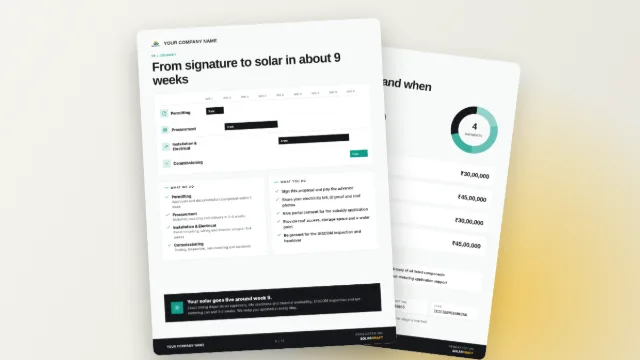
You (or your EPC) apply to the DISCOM or through the PM Surya Ghar portal, the DISCOM checks feasibility, the system is installed, the DISCOM inspects it and replaces your meter with a bidirectional one, and the connection is commissioned. Timelines vary by DISCOM, season and paperwork quality.
| System size | Typical approval time |
|---|---|
| Up to 3 kW | 7–15 days |
| 3–10 kW | 15–30 days |
| Larger systems | Longer; depends on network checks |
These are typical ranges, not guarantees — see our step-by-step DISCOM approval guide. Correct system sizing keeps your net-metering application simple.
What to check before signing up
- Your state's settlement rules for surplus units at year end.
- Your sanctioned load; a load increase may be needed for a larger system.
- Who will handle the paperwork — ideally your EPC.
- Whether your system type qualifies; standard on-grid systems are simplest. See on-grid vs off-grid vs hybrid.
- Any meter, testing or application fees your DISCOM charges.
Common misunderstandings
- “My bill will be zero.” Energy charges can drop close to zero, but fixed charges and duties usually remain.
- “I'll earn money by exporting.” Surplus is mostly credited in units, and year-end surplus may earn little.
- “Solar will work during a power cut.” Standard on-grid systems switch off when the grid fails, for safety.
- “Bigger is always better.” Over-sizing adds cost for units that may not be credited at full value.
“Size for the units you use. Let the meter handle the timing.”
Net metering and payback
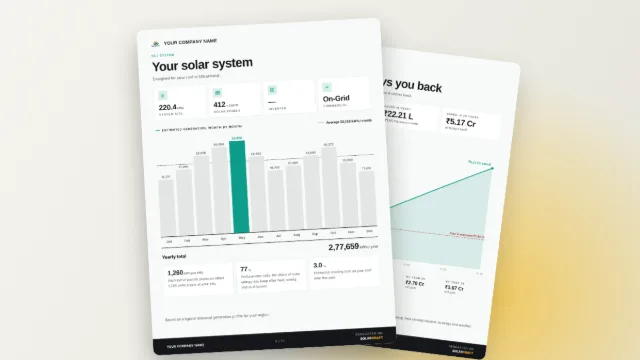
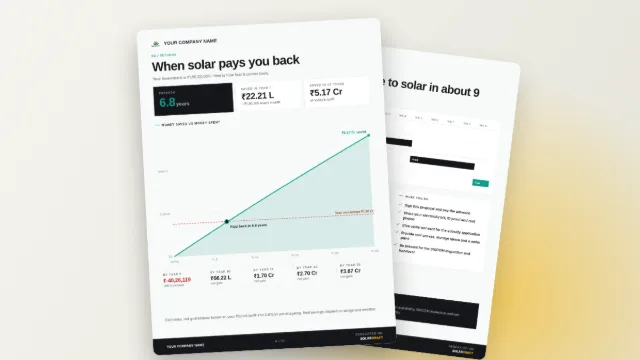
Net metering is what lets daytime generation offset evening use, so it has a direct effect on payback. Units used directly save your full tariff; credited units do the same under one-for-one net metering, but surplus at year end may be worth little. EPCs can show monthly generation against the customer's consumption in a SolarDraft proposal, so the customer sees how much will be offset. Our short video on DISCOM-ready proposals shows the idea.
FAQ
Do I need a battery with net metering?
No. Net metering works like a virtual battery. You'd only add one for backup during outages — see do you need a battery?
Will I get paid for extra units?
Usually surplus carries forward month to month; year-end treatment depends on your state.
Is net metering available for commercial buildings?
Often yes, within the size limits and rules of your state. Larger systems may fall under net billing, gross metering or open access instead.
Can I apply for net metering for an existing solar system?
Usually, if it is a compliant grid-connected system. The DISCOM will inspect it before fitting the bidirectional meter.