Choosing a solar system type is really about how much you value grid backup versus battery independence — and how much you're willing to pay for it.
Customers often ask for “solar with battery” by default, then discover it costs much more than they expected. Others choose a plain on-grid system and are surprised when it switches off during a power cut. Getting the system type right at the proposal stage avoids both problems. This guide explains how on-grid, off-grid and hybrid systems work, what each needs, how they compare on cost and backup, and which suits most Indian homes and businesses.
Key points
- On-grid is the cheapest and most common choice: it uses net metering but switches off during power cuts.
- Hybrid adds a battery and a hybrid inverter so essential loads keep running during outages.
- Off-grid has no grid connection at all and must be sized for the worst weather, which makes it the most expensive per unit.
- Most PM Surya Ghar installations are on-grid; batteries buy resilience, not faster payback.
The three types at a glance
- On-grid — cheapest, exports surplus via net metering, but no power during outages.
- Off-grid — fully battery-based, independent of the grid, highest upfront cost.
- Hybrid — grid-connected with battery backup for outages.
On-grid
Panels feed an on-grid inverter connected to your building's supply. During the day, solar powers your loads first; surplus goes to the grid through a bidirectional meter and is credited against your bill under net metering. At night you draw from the grid as usual. For safety, the inverter shuts down when the grid fails, so there's no backup. On-grid is the simplest, lowest-cost option and the standard choice for subsidised residential systems.
Off-grid
Panels charge a battery bank through a charge controller or off-grid inverter, and the battery supplies your loads. There's no connection to the grid, so the system must be sized for your worst days — cloudy weeks in the monsoon — which makes it the most expensive per unit of power. It suits remote homes, farms and sites without a reliable grid connection.
Hybrid
A hybrid inverter connects panels, a battery and the grid. Solar powers your loads and charges the battery; surplus can still be exported under net metering where allowed; and during a power cut, the battery keeps essential loads running. It costs more than on-grid because of the battery and inverter, but less than full off-grid because the grid covers long cloudy spells.
“Most Indian homes don't need independence from the grid — they need backup for a few hours.”
Side-by-side comparison
| On-grid | Hybrid | Off-grid | |
|---|---|---|---|
| Battery needed | No | Yes, sized for backup hours | Yes, sized for bad days |
| Power during outages | No | Yes, for backed-up loads | Yes |
| Net metering | Yes | Usually, subject to DISCOM rules | No |
| Relative cost | Lowest | Medium | Highest |
| Maintenance | Minimal | Battery care | Battery care, more critical |
| Payback | Fastest | Slower | Hard to compare; replaces other sources |
| Best for | Stable supply, lowest payback | Frequent cuts, critical loads | No grid access |
What each system needs
| Component | On-grid | Hybrid | Off-grid |
|---|---|---|---|
| Solar panels | Yes | Yes | Yes, usually more |
| Inverter | On-grid | Hybrid | Off-grid / charge controller |
| Battery | None | Backup-sized | Days of storage |
| Bidirectional meter | Yes | Usually | No |
| DISCOM approval | Yes | Yes | No grid connection |
| Backup wiring | No | Essential-load circuit | Whole site |
Which one fits which customer
| Customer | Usual best fit | Why |
|---|---|---|
| City home with stable supply | On-grid | Lowest cost, fastest payback, subsidy-friendly |
| Home in an area with daily cuts | Hybrid | Keeps fans, lights and Wi-Fi running |
| Home office or clinic | Hybrid | Critical loads can't stop |
| Shop with billing systems | Hybrid, or on-grid plus UPS | Avoids downtime during short cuts |
| Farmhouse or remote site | Off-grid | No reliable grid connection |
| Factory with daytime load | On-grid | Solar matches daytime use; savings drive the decision |
How to decide
- How often does your power go? If cuts are rare and short, on-grid gives the best return.
- What must keep running? If it's medical equipment, a home office or a shop's billing system, consider hybrid. See do you need a battery?
- Is there a grid at all? If not, off-grid is the only option.
- What's your budget? On-grid usually has the fastest payback; batteries add resilience, not savings.
- Do you already have a home inverter-battery (UPS)? Many homes keep it for backup and add an on-grid solar system for savings.
Sizing differences
An on-grid system is sized to your yearly consumption — see how many panels you need. A hybrid system uses the same panel sizing, with a battery added for the backup hours you want. An off-grid system is sized the other way round: start from the daily energy you need, add enough battery for cloudy days, then add panels to recharge the battery even in poor weather. That last step is why off-grid systems often need more panels for the same usage.
Subsidy and approvals
Most PM Surya Ghar installations are on-grid — see our subsidy guide. Grid-connected systems go through the DISCOM's approval process for net metering. If you're considering a hybrid system under a subsidy scheme, confirm with your installer and DISCOM how it will be treated before you sign.
Inverter choice follows system type
On-grid systems use on-grid string or microinverters; hybrid systems need a hybrid inverter that manages the battery. If you might add a battery in the next few years, choosing a hybrid-ready inverter now can save a replacement later. Read string vs micro inverters for the details.
“Decide what must run during a power cut. That answer chooses the system type for you.”
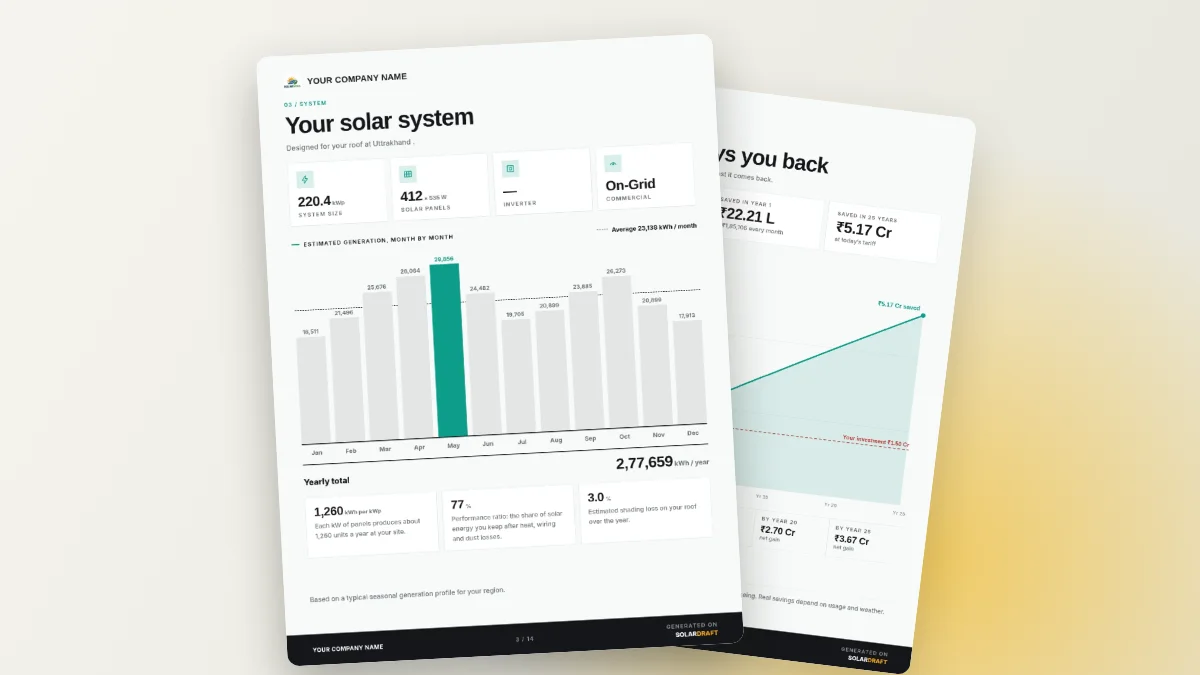
For EPCs, the system page of a SolarDraft proposal shows the system type, size and monthly generation clearly — see it in the proposal samples. Battery (BESS) design is also part of SolarDraft, so hybrid and off-grid systems can be planned alongside the panels.
FAQ
Why does my on-grid system stop during a power cut?
It's a safety requirement, so the system doesn't send power into lines being repaired. A hybrid inverter with a battery can supply backup safely.
Is off-grid cheaper in the long run?
Rarely, where a grid connection is available. Batteries need replacing over the system's life, which adds cost.
Can I convert an on-grid system to hybrid later?
Usually yes, by adding a battery with a hybrid inverter or a battery-coupled inverter. Planning for it at the start keeps the upgrade simpler.
Which system type gets the PM Surya Ghar subsidy?
The scheme is built around grid-connected rooftop systems. Check with your installer and DISCOM how a hybrid setup is treated before applying.