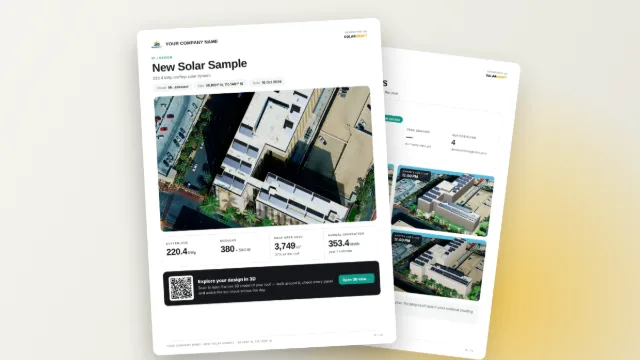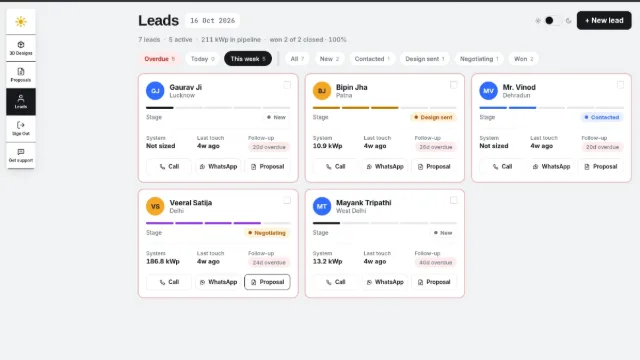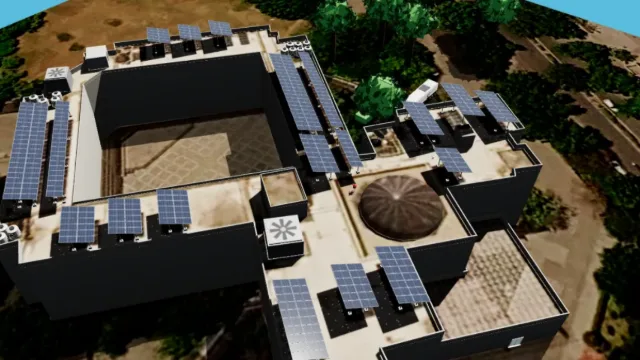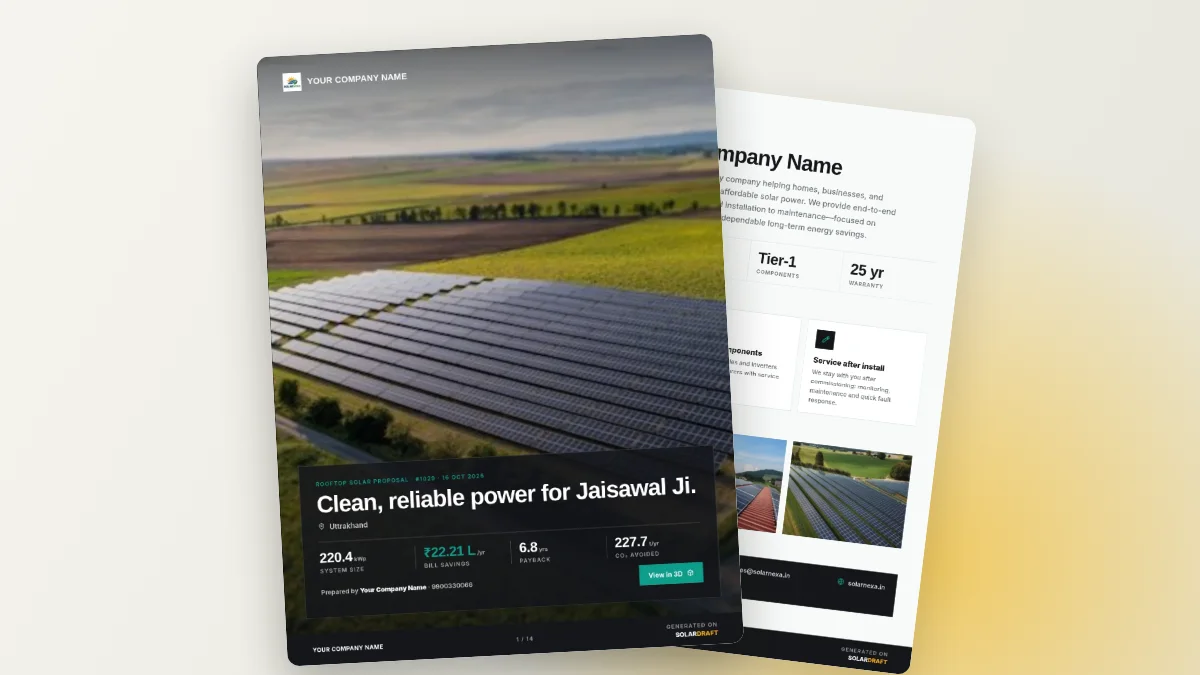
Proposal software ranges from glorified PDF generators to full 3D design engines. The difference shows up in close rates, site surprises and how many proposals you have to rewrite.
For an Indian solar EPC, a proposal tool has one job: turn an enquiry into a document the customer trusts enough to sign. That means accurate design, honest numbers, India-specific subsidy and GST handling, and a smooth path from “proposal sent” to “order confirmed”. This buyer's guide lists the features that matter, how to test them in a demo, how to think about cost, and the mistakes EPCs make when choosing a tool.
Key points
- The proposal should be built from a design of the customer's real roof, with a year-round shading analysis — not a template.
- Subsidy, GST, generation, savings and payback should all come from the same design, automatically.
- The same model should produce engineering outputs (Structure BOM, drawings, SLD) and hand the lead to a CRM.
- Test the tool on a real roof during the demo, and compare the full yearly cost for your team, including GST.
What to check for
1. Real roof design
The tool should let you model the customer's actual roof on satellite imagery, place panels around tanks, staircase rooms and parapets, and show the result in 3D. If the “design” is a stock image with a kW number on it, customers notice. Read 3D design vs guesswork for why this matters.
2. Shading analysis
Ask to see a year-round shading result on a roof with a real obstruction. Good tools colour each panel by sun exposure, so you can move panels out of the shade before quoting. More on this in Rooftop Shading: The Silent Killer of Solar Output.
3. Subsidy and GST handled correctly
For residential customers, the proposal should show the PM Surya Ghar subsidy on its own line, calculated from the actual system size, with GST shown clearly. A wrong subsidy figure is one of the fastest ways to lose trust.
4. Clear financial story
Generation by month, yearly savings, payback period and long-term savings should all come from the design, not from a separate spreadsheet. A payment schedule page avoids confusion about when money is due.
5. Engineering outputs
The same design should give your install team what they need: Structure BOM, PV array layout, string routing and a Single Line Diagram. That keeps the system you sell and the system you build identical.
6. Roof and project types
Check that the tool supports the work you actually do: RCC terraces, tin sheds, elevated structures, petrol pump and parking canopies, ground-mounted arrays and, if relevant, agrivoltaics. A tool limited to simple residential roofs becomes a ceiling as you grow into commercial projects.
7. Branding and sharing
Your logo, company details and past work should appear on the proposal, and it should be easy to share as a PDF or a link on WhatsApp, where most Indian customers will read it.
8. CRM handoff
Once the proposal goes out, someone has to follow up. If the tool connects to a CRM, the lead, the proposal and the next follow-up date stay together. See why EPCs need a CRM.
9. Works on a phone
Much of an EPC's selling happens on site. A tool that lets you design and send a proposal from a phone, during the visit, often wins the deal before competitors have opened a laptop.
“The best proposal software makes the customer's own roof the hero of the pitch — not a stock rendering.”
| Feature | Why it matters |
|---|---|
| Real 3D roof | Trust — the customer recognises their home |
| Shading analysis | Accuracy — realistic generation and payback |
| Automatic subsidy | Credibility — no inflated or vague figures |
| Engineering drawings | Execution — install matches the sale |
| Roof and project types | Growth — the tool keeps up with bigger jobs |
| CRM handoff | Conversion — no proposal left without a follow-up |
| Published pricing | Budgeting — know the yearly cost upfront |

How to run a useful demo
A sales demo on a perfect sample roof tells you little. Bring a real lead and test the tool on it:
- Give the address of a roof with tanks, a staircase room and a nearby building.
- Time how long it takes to model the roof and place panels.
- Run the shading analysis and check that the obstacles cast realistic shadows.
- Generate the proposal and check the subsidy, GST, generation and payback.
- Download the drawings and ask your installer whether they could build from them.
Questions to ask
- Can you design this specific roof right now, on my phone?
- How long does it take to go from design to a finished proposal?
- Can I edit pricing, panels and inverters to match my suppliers?
- What is the total yearly cost for my team, including GST?
- Is there a free plan or trial so I can test it on real leads?
Thinking about cost
Price proposal software against what it replaces and what it wins, not against zero. A tool that saves an hour per proposal, prevents one downsized system a month or wins a few extra orders a year usually pays for itself quickly. Compare plans on the limits that matter to you — designs or proposals a year, largest project size, users, white-labelling — and check whether prices include GST. SolarDraft publishes every plan and price on its price list.
| Cost question | Why ask it |
|---|---|
| Is the price per year, per user or per design? | Changes the real cost as you grow |
| Is GST included? | Avoids an 18% surprise |
| What is the largest project a plan covers? | Commercial jobs may need a higher plan |
| Are design, proposal and CRM separate purchases? | Separate tools mean retyping data |
| Is there a free plan? | Lets you test on real leads first |
Mistakes to avoid
- Choosing on the look of the PDF alone, without testing the design and shading.
- Buying separate tools for design, proposals and CRM that don't share data.
- Ignoring how the tool handles Indian subsidy, GST and INR pricing.
- Skipping a test on a difficult roof — that's where tools differ most.
See this in action with Solar Proposal, paired with Solar 3D Design, or browse real output on the samples page. If you're comparing vendors, our side-by-side posts on Arka360 and Solar Ladder may help.
FAQ
Do I need separate design and proposal software?
Not if one tool does both well. Keeping design, proposal and CRM together avoids retyping numbers and the errors that come with it.
Is free proposal software good enough?
A free plan is a good way to start and test a tool on real leads. As your volume grows, check the limits on designs, proposals and project size.
How long should a proposal take to make?
With a design-first tool, a residential proposal can be ready in minutes, often during the site visit.
What do customers look at first in a proposal?
Usually their own roof, the price after subsidy and the payback period. Make those three easy to find.