The inverter converts DC from the panels into usable AC power — and the type you choose changes how shading, faults, monitoring and future batteries behave.
Panels get most of the attention in a solar proposal, but the inverter is the system's brain. It sets how panels are wired, how the system copes with shade, what monitoring the customer gets, and whether a battery can be added later. It's also usually the component with the shortest warranty. This guide compares string inverters, microinverters, optimisers and hybrid inverters for Indian rooftops, explains sizing and phase, and lists what to check before you choose.
Key points
- String inverters are the cost-effective standard for most Indian homes and businesses; multiple MPPTs handle two roof faces or partial shade.
- Microinverters and optimisers work at panel level, so one shaded panel doesn't drag down the rest, at a higher cost per watt.
- Hybrid inverters add battery support for backup during power cuts; plan for one at the start if backup may be needed.
- Inverters usually last 10–15 years, so warranty, service network and a shaded, ventilated location matter.
The main types
- String inverters — one inverter for a group of panels, lower cost.
- Microinverters — one per panel (or small group), isolate shading and fault impact.
- Power optimisers — small devices on each panel that work with a string inverter.
- Hybrid inverters — add battery support and backup during outages.
String inverters
Panels are wired in series into one or more “strings”, and each string feeds the inverter. Most Indian residential and commercial systems use string inverters because they're cost-effective, proven and easy to service. Single-phase models cover typical homes; three-phase models are used for larger homes and businesses.
The key feature to look at is the number of MPPTs (maximum power point trackers). Each MPPT handles one string independently, so a roof with panels facing two directions, or one shaded section, can be split across two MPPTs rather than letting the weaker section drag down the rest. This is why string routing is part of the design, not an afterthought.
Microinverters
A microinverter sits behind each panel (or a small group of panels) and converts power right there. One shaded or dirty panel only affects itself, every panel can be monitored individually, and the roof carries low-voltage AC instead of high-voltage DC. The trade-off is a higher cost per watt and more electronics on the roof to service.
Power optimisers
Optimisers are a middle path: panel-level devices that reduce the impact of mismatch and shade, while a central string inverter does the conversion. They add cost and parts but can help on complex roofs.
Hybrid inverters
A hybrid inverter can charge and discharge a battery and keep essential loads running during a power cut. If backup matters now or later, plan for one at the start. See do you need a battery with solar?
“With a string inverter, one shaded panel can drag down its whole group — with micros, it doesn't.”
| Type | Best for | Trade-off |
|---|---|---|
| String | Simple, unshaded roofs; most homes and businesses | Shade on one panel affects its string |
| String with multiple MPPTs | Roofs with two orientations or partial shade | Needs careful string design |
| Micro | Partially shaded or complex roofs | Higher cost per watt |
| Optimisers | Complex roofs needing panel-level control | Extra parts on the roof |
| Hybrid | Homes needing backup | Battery cost |
Comparing them on what matters
| String | Micro | Hybrid | |
|---|---|---|---|
| Cost per watt | Lowest | Highest | Medium, plus battery |
| Shade tolerance | Per string (per MPPT) | Per panel | Per string |
| Monitoring | System or string level | Panel level | System level, with battery data |
| Backup during outages | No | No (unless paired with storage) | Yes, for backed-up loads |
| Service | One unit, easy access | Many units on the roof | One unit plus battery |
Sizing the inverter
An inverter is usually sized close to the panel capacity, often slightly below it. The ratio of panel (DC) capacity to inverter (AC) capacity is called the DC-to-AC ratio. Because panels rarely produce their full rated power in real conditions — heat, dust and sun angle all reduce output — a modest ratio above 1 is common and keeps the inverter working efficiently for more of the day. Your EPC chooses the ratio within the inverter manufacturer's limits and the DISCOM's rules.
| Panel capacity | Typical inverter | Phase |
|---|---|---|
| 2–3 kW | Around 2–3 kW | Usually single-phase |
| 5 kW | Around 4–5 kW | Single or three-phase, by connection |
| 10 kW | Around 8–10 kW | Usually three-phase |
| Commercial | One or more three-phase units | Three-phase |
The inverter must also match your electricity connection: a single-phase home needs a single-phase inverter, and larger systems often need a three-phase connection. Check this against your sanctioned load before quoting — see how many panels you need.
How to choose
- Start with shading — run a year-round shading analysis. If most panels get full sun, a string inverter is usually the best value.
- Count the roof faces — different orientations need separate MPPTs or panel-level electronics.
- Match the size and phase — inverter capacity should suit the array and your connection.
- Think about the future — if a battery is likely, choose a hybrid now.
- Check the warranty and service network — inverters are the part most likely to need a repair. See the warranty guide.
- Check certifications — inverters sold in India must meet the required standards; ask your EPC for the certificates.
Installing for a long life
Inverters dislike heat. Mount them in a shaded, ventilated spot, away from direct afternoon sun and rain, with clearance around the vents. Keep the area dust-free and check the display or app regularly. Most failures announce themselves through error codes first, so a quick look at the app each week catches problems early — see the maintenance checklist.
Where inverters fit in the design
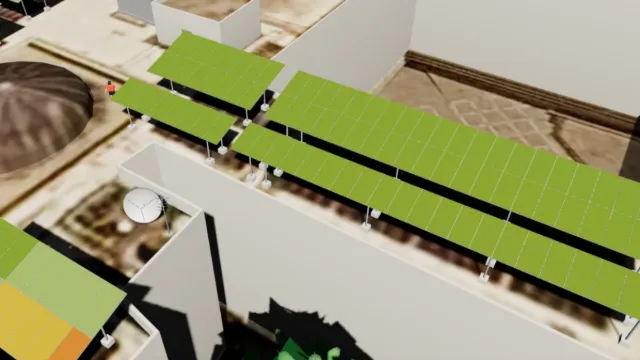
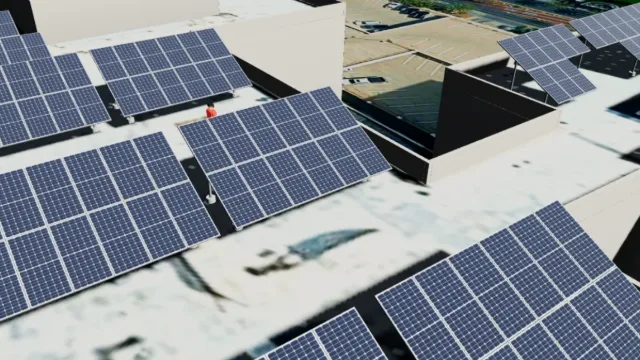
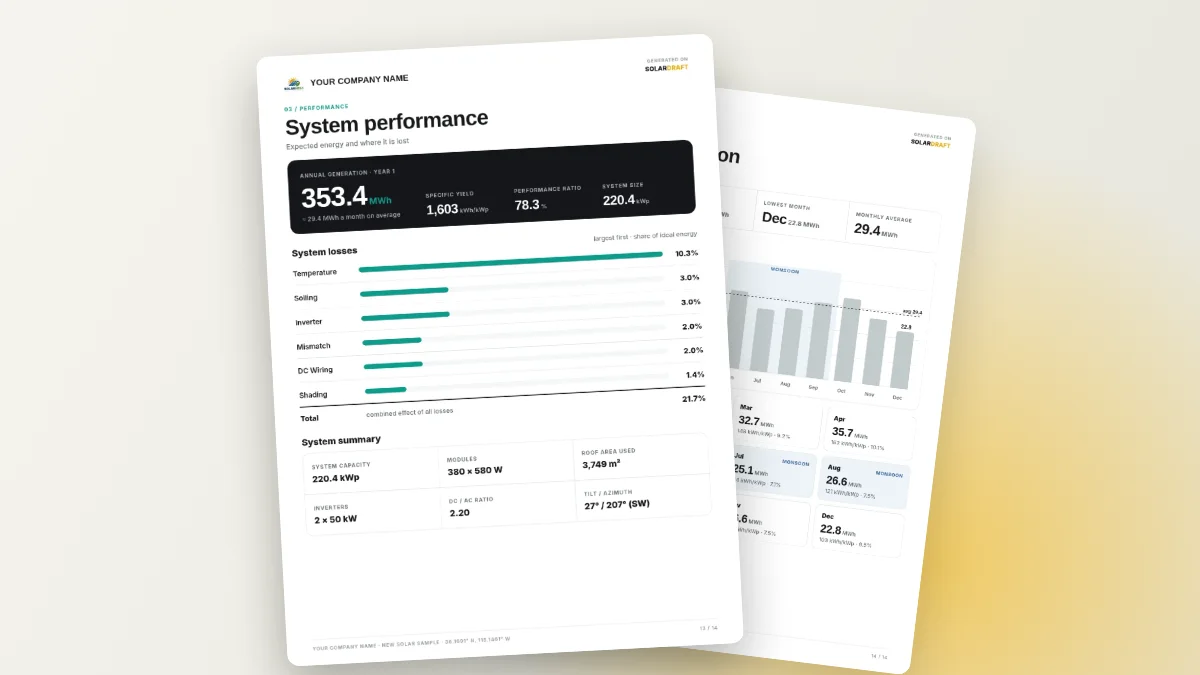
Inverter choice, string layout and cable routes are decided together. SolarDraft's Solar 3D Design produces string route drawings and a Single Line Diagram from the same 3D layout, so the strings you planned around the shade are the strings the crew wires. The system performance page in our proposal samples shows how inverter and other losses are reported to the customer.
An inverter swap is usually the one replacement to budget for — see how long solar systems last.
FAQ
Are microinverters worth it in India?
On heavily shaded or complex roofs, they can be. On open, unshaded roofs, a good string inverter usually gives better value.
How long does an inverter last?
Typically 10–15 years, so plan for one replacement over a 25-year system life.
Can I use my existing home inverter (UPS) for solar?
A standard home UPS isn't a grid-tied solar inverter. Some solar-ready UPS models exist, but grid-connected systems with net metering need a proper on-grid or hybrid inverter.
Where should the inverter be installed?
In a shaded, ventilated place close to the main distribution board, protected from rain and direct sun, with easy access for service.